ClearPath.
A clearer way to walk. Built with a team at BigRedHacks 2026, ClearPath combines Cornell’s walking paths with live obstacle reports to help people navigate temporary campus hazards.
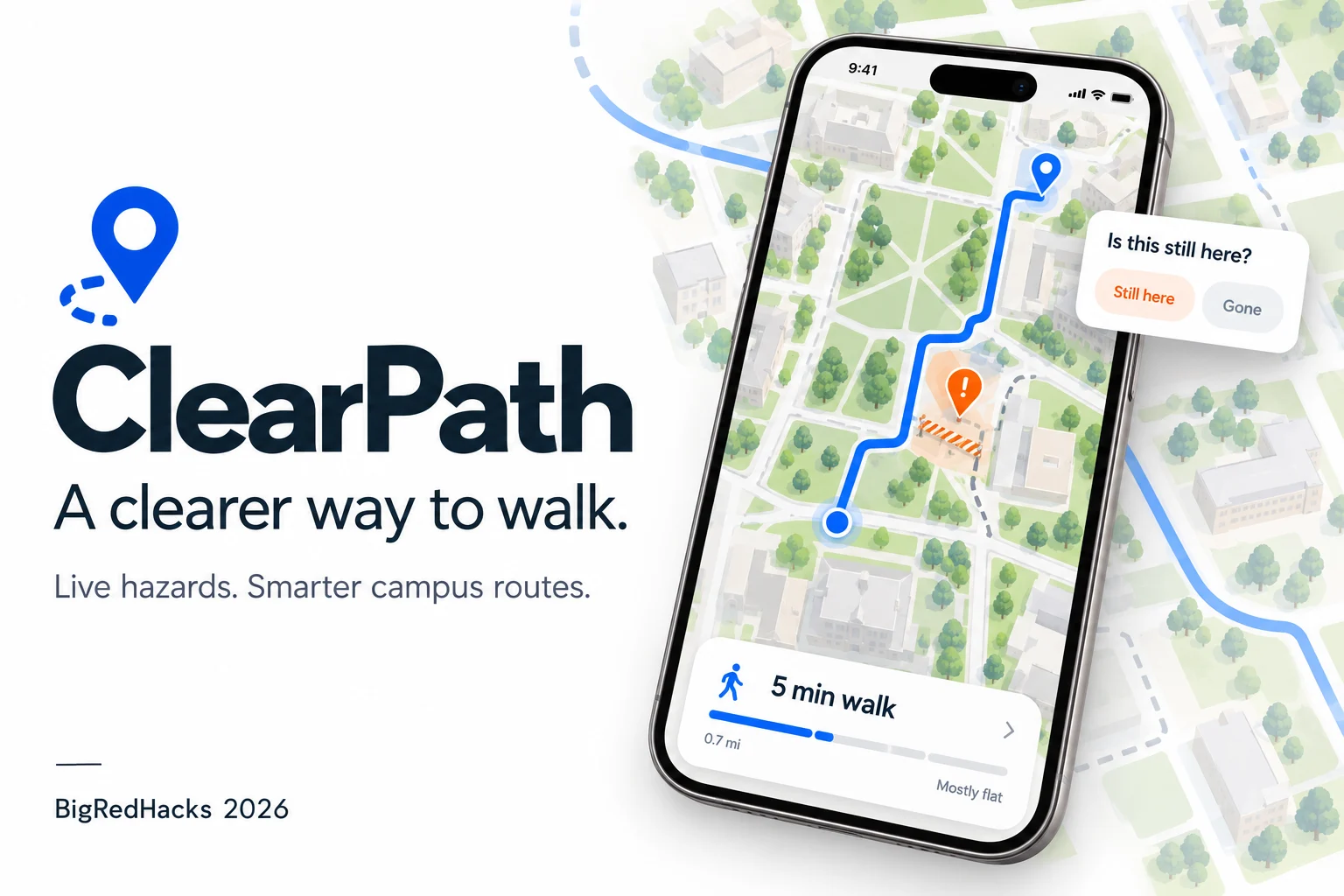
See ClearPath in action.
From reports to routes.
Choose campus landmarks or place start and destination pins, compare walking routes, and report obstacles at an adjustable location. New hazards along an active route trigger a reroute proposal that the walker can accept or dismiss.
Reports fade over time as their routing penalties decay. When a walker passes a reported hazard, a three-second “Is this still here?” prompt lets them confirm it or mark it gone. Ignoring the prompt leaves the report unchanged.
The dashboard also provides separate simulations for impacts, bag tumbles, avoidance, and decay, so experiments don’t add fictional hazards to the live feed.
My contribution.
I worked on the mobile navigation and sharing lifecycle: recovering route planning after errors, cancelling stale location requests, showing interrupted hazard connections, and keeping sensor-sharing state accurate.
I also added the passed-hazard verification prompt, improved keyboard pin placement and focus recovery, and serialized native health-sharing startup, shutdown, and polling. These changes help the interface stay predictable when routes, permissions, or connections change.
Behind the build.
- JavaScript, HTML, and CSS power the dashboard and mobile web interface. Leaflet draws interactive maps using OpenStreetMap tiles and walking geometry.
- Node.js serves the frontend and routing API. WebSockets, through the
wslibrary, keep connected maps updated with live hazard snapshots. - Dijkstra’s algorithm finds paths through the campus graph. A KD-tree spatial index helps match reports to nearby walking segments, while temporary edge penalties make hazards affect route choices.
- Exponential decay reduces finite penalties over time. Penalties are virtual routing costs, not extra walking distance. The mobile alternative currently avoids active hazard edges; the direct route gives a distance-based comparison.
- Capacitor bridges the web app to native iOS and Android features. Swift/Core Motion and Kotlin/SensorManager provide motion samples; HealthKit and Health Connect supply available mobility records for local analysis. Raw health measurements stay on the phone.
- esbuild bundles the frontend, and the Node test runner and GitHub Actions support automated checks.
This is a Cornell-focused hackathon prototype. Reports and sessions live in memory and reset when the backend restarts. Sensor detections are possible impacts rather than verified potholes; physical-device accuracy and a complete wheelchair routing profile still need validation.